
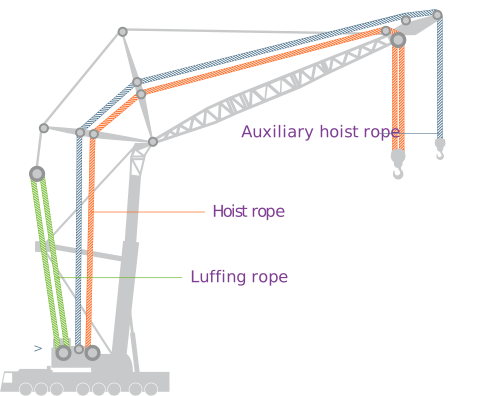
The main hoist steel wire rope of a mobile crane is the "lifeline" of the entire machine, specifically responsible for vertically lifting heavy objects, and its safety and reliability requirements are extremely high. It typically uses high-strength alloy steel wire, and its structure often features line contact or compacted strand design to resist fatigue and wear. The rope core can be a fiber core (lightweight) or a metal core (heavy load), and is often galvanized to enhance corrosion resistance.
When selecting a model, attention should be paid to its anti-rotation capability (e.g., 35W×K7 structure), safety factor (≥5 for ordinary lifting, 6-8 for hazardous materials lifting), and ensuring that the ratio of pulley diameter to wire rope diameter is ≥20.
15×K7-IWRC
35(W)×7
35(W)×K7
The luffing steel wire rope of a mobile crane is a key component connecting the winch and the boom. Its winding and unwinding actions adjust the boom's elevation angle, thereby changing the working radius and lifting height. The wire rope must possess wear resistance, rotational resistance, and compression resistance, and is often galvanized to enhance corrosion resistance.
8×26WS-IWRC
8×K26WS-IWRC
The steel wire rope used for the boom extension of a mobile crane is indeed the core transmission component for realizing the boom's extension and retraction. A hydraulic cylinder drives the wire rope and pulley system to achieve synchronous extension and retraction of multiple boom sections, thereby changing the working radius and lifting height. When the hydraulic cylinder piston rod extends or retracts, it drives the pulley block, causing the wire rope to move accordingly, pulling the inner boom section to extend or retract, thus achieving synchronous extension and retraction of multiple boom sections.
High-strength wire ropes (such as 19-strand galvanized steel core structure with a breaking strength of 1960 MPa) are typically used, equipped with an automatic tensioning device to ensure transmission efficiency. A safety factor of no less than 4 is required to ensure operational safety.
8×K26WS-IWRC