
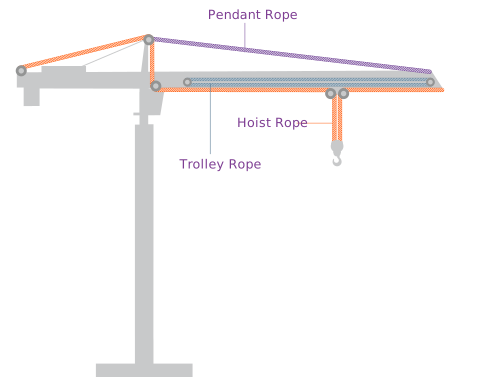
The main hoisting steel wire rope of a tower crane is the most crucial load-bearing component, specifically responsible for lifting heavy objects, and requires extremely high safety and reliability.
Its structure is typically double-wound or multi-wound, made by twisting high-strength steel wires into strands, then into a rope, with a core (metal or fiber) providing support and lubrication. Common types include interlaced twist (good stability) and unidirectional twist (more flexible), and based on the contact method, they are classified as point contact, line contact, and surface contact, with line contact being the most widely used. The wire rope must possess high strength, high flexibility, the ability to withstand repeated bending and dynamic loads, and resistance to wear and fatigue. A high safety factor is required: typically ≥5, ensuring operational safety.
4×V39FC-FC
6×29F-IWRC
6×36WS-IWRC
15×K7-IWRC
18×7-WSC(same as 19×7)
18×K7-WSC(same as19×K7)
35(W)×7
35(W)×K7
Tower crane pendant ropes, also known as counterweight boom ropes, are specialized steel wire ropes for tower cranes. Their core function is to stabilize the counterweight boom, prevent overturning, and ensure the safety of the entire machine. The wire rope is mainly used to connect the tail end of the counterweight boom to the tower body, balancing the overturning moment generated by the boom. They often employ a double-wound or multi-wound structure, balancing strength and flexibility.
8×26WS-IWRC
8×K26WS-IWRC
8×K26WS-PWRC
The trolley steel wire rope of a tower crane is a key component that drives the trolley back and forth on the boom, enabling the horizontal movement of the load. Unlike load-bearing ropes such as hoisting ropes and luffing ropes, it primarily bears horizontal traction force, therefore its safety factor requirement is slightly lower, generally 3 (5-6 for hoisting/luffing ropes). It commonly uses interlaced twist, which is resistant to torsion and less prone to loosening. Line contact is the most common, offering fatigue resistance and a long service life. Fiber cores or steel wire cores are frequently used, balancing lubrication and strength.
6×19M-FC
6×19S-FC
6×19S-IWRC